Twin ESCAPADE Probes Slingshot Past Earth Toward Mars
BulletinTwin NASA spacecraft completed powered Earth flybys to begin their journey toward Mars, arriving in September 2027.
- 1,000miles above Earth at closest approach
- 9minute trans-Mars injection engine burn
- 2027year the twin probes reach Mars
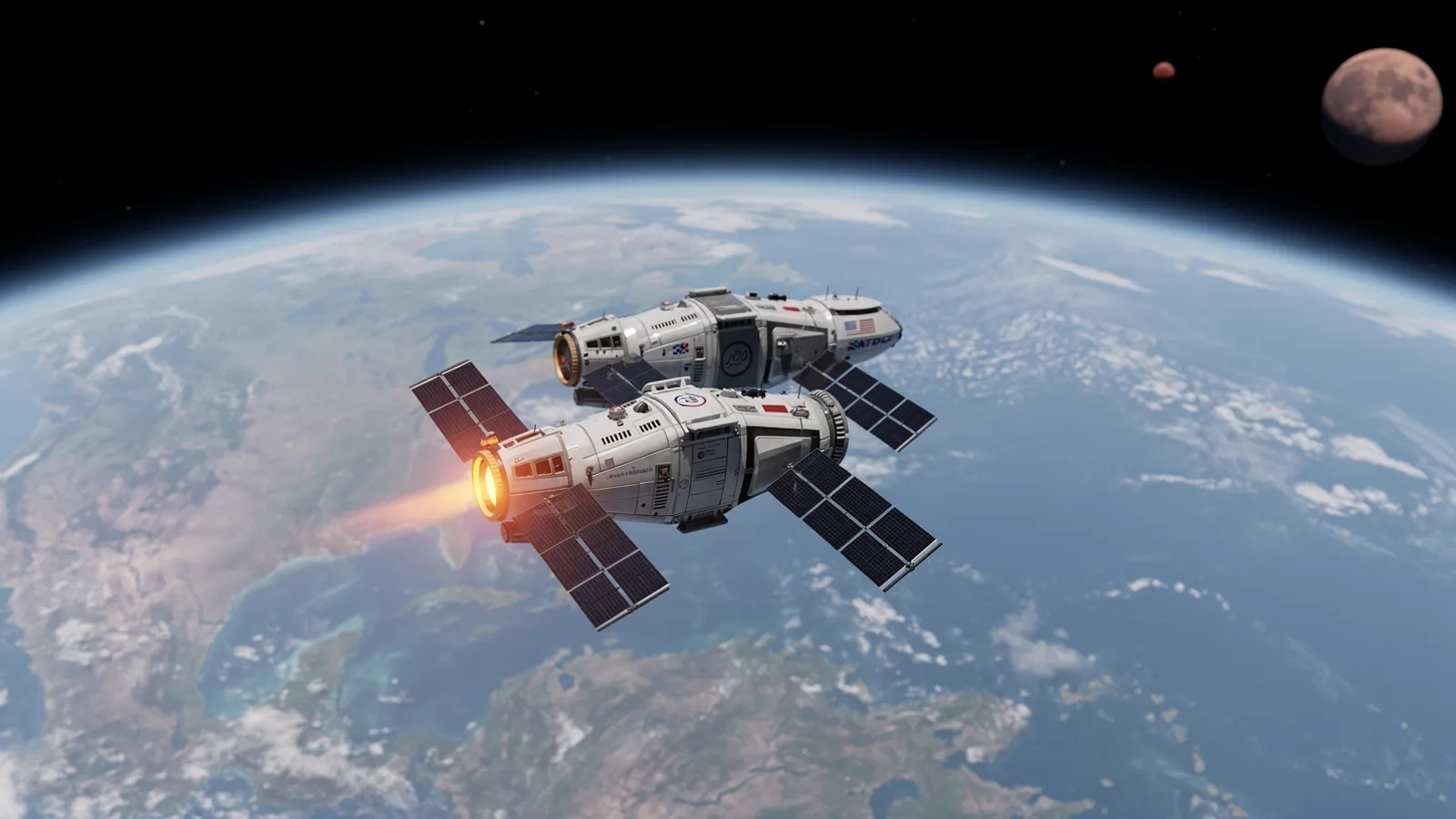
NASA's twin ESCAPADE spacecraft successfully executed powered flybys of Earth over the weekend, utilizing the planet's gravity and sustained engine burns to set a direct trajectory toward Mars, according to NASA Science.
CAPE CANAVERAL, Fla. (Stratosyn) · The two spacecraft, formally known as the Escape and Plasma Acceleration and Dynamics Explorers, completed maneuvers to gain the speed needed for interplanetary transit. Each probe swept past Earth, relying on the planet's gravitational pull combined with a prolonged engine firing to propel itself outward into deep space.
The first spacecraft made its closest approach at about 5 a.m. EST on Saturday, Nov. 7, passing roughly 1,000 miles above Earth before initiating an approximately 9-minute trans-Mars injection burn. The second twin followed an identical sequence, completing its closest approach at about 6 a.m. EST on Monday, Nov. 9.
A novel holding pattern
The twin probes initially launched from Cape Canaveral Space Force Station on Nov. 13, 2025. Because Earth and Mars were positioned on opposite sides of the Sun at the time of launch, mission planners directed the probes into an innovative holding pattern rather than sending them straight to Mars.
The spacecraft entered a first-of-its-kind, kidney-bean-shaped loiter orbit around Lagrange point 2, roughly one million miles from Earth. They circled this orbital vantage point, waiting until Earth and Mars moved into the proper alignment for an efficient transfer trajectory.
Atmospheric research at Mars
Once celestial positions aligned, the probes traveled back toward Earth to execute their dual gravitational slingshots. NASA Science reported that both probes performed smoothly during their respective burns and flybys, keeping them on course for their interplanetary trek.
When the twin probes arrive at their destination in September 2027, they will gather observations of Mars's upper atmosphere. The scientific mission is designed to study the Martian atmospheric environment and monitor how space weather interacts with the planet.
This bulletin is based on reporting and materials from NASA Science, rewritten in our own words.